News Bulletin
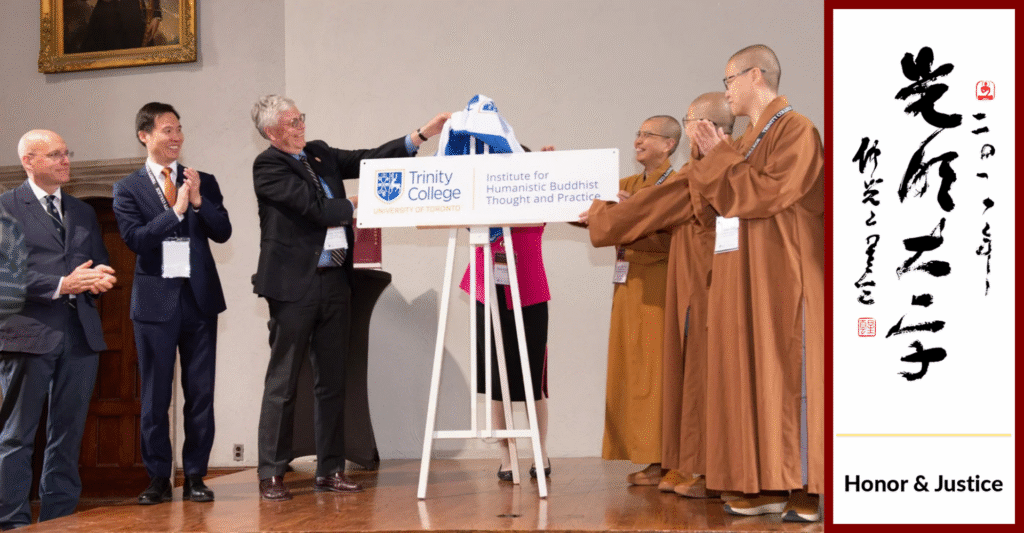
Fo Guang Shan Philippines Advances Global Dialogue at University of Toronto Inaugural Conference
News Bulletin No. 22
By: Heidi Emelo
Toronto, Canada — Scholars and administrators from the Philippines took center stage at the historic International Inaugural Conference of the Institute for Humanistic Buddhist Thought and Practice, held from May 6–8, 2026, at Trinity College, University of Toronto, and the Fo Guang Shan Temple of Toronto.
Under the timely theme, “Navigating Conflict: Humanistic Buddhism and Comparative Theology in a Divided World,” the three-day event drew over 500 global participants. The conference featured two keynote lectures, two plenary forums, and seven panel sessions, with 17 academic papers focusing deeply on Fo Guang Shan (FGS), Venerable Master Hsing Yun, and Humanistic Buddhism studies.
Representing the vibrant academic landscape of the Philippines were key delegates from Guang Ming College (GMC)—the first Humanist Buddhist informed college in the Philippines—and the University of San Carlos (USC).
The active participation of the Philippine delegation highlighted a strategic shift as FGS Philippines increasingly immersed themselves in high-level international research. At this conference, Philippine scholars shared the stage with representatives from the world’s most prestigious institutions, including Harvard University, the University of Cambridge, Columbia University, the University of California, Berkeley, and the University of Toronto.
The Philippine delegation was led by educators from USC, Dr. Maria Majorie Purino (Chair of the Department of Philosophy), and from GMC, including Katherine Mae G. Sabate (Office of Academic Affairs Director), Heidi Salih Emelo-Ato (Chair of the Bachelor of Performing Arts in Theatre Program), and Miguel Antonio S. Lorino (CCA Lecturer, Instructor for CCA Plant-based Foundation Class-Life Education).
GMC faculty explored interfaith connection through food in their paper, “Faith on the Plate: Plant-Based Culinary Education in a Comparative Theological Framework,” while Dr. Purino examined “The Ethics of Humanistic Buddhism.” This high-level academic engagement significantly strengthened local propagation, establishing the Philippines as a vital intellectual hub for Humanistic Buddhism.
By contributing to this global discourse, these educators strengthened the propagation of Humanistic Buddhism back home, proving that the philosophy is a rigorous, interdisciplinary academic tool capable of addressing modern, real-world crises.
The conference discussions reflected the growing international scope of Humanistic Buddhism, spanning comparative theology, interfaith dialogue, migration, digital Buddhism, ethics, and social engagement.
In a keynote lecture that drew profound attention, Rev. Dr. Francis X. Clooney, S.J., Parkman Professor of Divinity at Harvard University, reflected on “Humanism and Comparative Theology in a Multi-Faith Future.” He praised Venerable Master Hsing Yun’s text, Humanistic Buddhism: Holding True to the Original Intents of Buddha, as a vital contribution to global religious dialogue, even recited passages from “My Understanding of Humanistic Buddhism” to underscore its contemporary relevance.
Other global scholars tackled urgent social issues:
- Rev. Dr. Michelle Voss emphasized that comparative theology must actively engage voices from the margins to meaningfully respond to rising social and religious polarization.
- Rev. Dr. Gregory Snyder examined poverty, shame, and liberation through reflections on collective karma and structural injustice, urging religious traditions to confront societal suffering.
- Keynote speaker Dr. Lewis R. Lancaster pointed toward the future, emphasizing the necessity of digital archives and AI-assisted research tools for comparative religious studies.
For the Philippine delegates, these global insights directly enrich their work at home. The integration of life education, plant-based foundations, and performing arts—core pillars at GMC—aligns perfectly with the conference’s call to confront structural issues through lived, localized practice.
As the conference concluded with closing remarks from Venerable Chueh Fan and Venerable Miao Fan on advancing compassion, wisdom, and coexistence, the Philippine delegation returned home with a reinforced mission. Through escalating involvement in international academic research, FGS Philippines and GMC are firmly establishing the Philippines as a vital intellectual hub for Humanistic Buddhism in Southeast Asia.
stratcom
0
Tags :